Veröffentlichungen
Artikel über aktuelle Ereignisse, Kultur, Volkswissenschaften, Beziehungen und vieles mehr, präsentiert von dem einzigartigen Standpunkt der Weisheit der Kabbala
The content is based on talks given by Dr. Michael Laitman and is written and edited by his students.

Ergebnisse 1 - 20 von 43431
Adhesion with the Creator Every Second

232.01Question: When should I analyze whether my actions are correct or not?

Answer: The correct analysis is made in the case when every second of your life you “attach” yourself to the Creator. “Life” means awareness. I am alive; I feel myself and I have some mission. As the song says: “There is only a moment between the past and the future; it is this moment that is called life.” In this moment you must merge with the Creator. This is what He allows you to do.

In this way you analyze the Reshimo (the spiritual informational gene). There is no other work here. If you concentrate only on this, it is very good. For the past and the future are like Klipot since they come to us from invented things. They generate various calculations and fears in us that have no relation to reality.

Comment: But a person has to deal with a combination of many factors.

My Response: I am not speaking about what you do at your work. There you work with the inanimate level: with people, with plans, and so on; there you must know how to work. I am speaking about your inner definitions, spiritual qualities, about what is connected with the Creator.

And with the Creator you have a simple calculation: I have no power over the past, the present, or the future. My work is only with what I have now. Whatever Reshimo He gives me, that I must now realize. And my realization of this Reshimo is adhesion with the Creator in the given second. Period! That is all.

I am not saying that this is how one should relate to life in general, this is how one should relate to our spiritual states. And in the material, I can plan my work a month ahead, a year ahead. One is not connected with the other. At work I deal with the inanimate level.
[354177]
From the Daily Kabbalah Lesson 3/16/26, Rabash, “What Is, ‘The Good Deeds of the Righteous Are the Generations,’ in the Work?”

Related Material:
The “Reshimo” That Lives Within The Person
Taming The Donkey
A Painting With White Spots

Meditation Lulls Egoism

564Question: Why is Eastern meditation so popular?

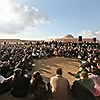
Answer: Eastern meditation is very popular in the world. I once visited a group of Americans in North Carolina in an extraordinarily beautiful place in the Smoky Mountains. They have a huge area of land at their disposal.

They receive donations from various sources that allow them to live very modestly, eat, have a roof over their heads, and meditate all the time. They asked us not to drive by car or even pass under their windows so as not to disturb them.

People sit for hours without the slightest movement; a person is completely immersed in oneself. The question is, what tools does he use to analyze it? As far as I understand from the science of Kabbalah, these people suppress their egoism, that is, they stop using it and want to achieve complete peace.

Of course, this is an egoistic desire, but it belongs to the lowest, smallest level of egoism, and therefore a person feels some freedom from the usual press of a huge thickness of egoism. Meditation lowers everyone to a level of egoism to which they can descend to.

Therefore, it seems to a person that he is achieving spiritual revelation. But this definition of the spiritual world differs from that given by the science of Kabbalah. People are able to invest a lot of effort and time with such meditation because it provides a powerful source of nourishment for the ego and brings a sense of comfort and fulfillment.

It is not an easy undertaking; it requires a person to step away from active life, but it offers substantial reward. The group I saw in North Carolina numbered hundreds of people, men and women. Moreover, there was a ban on any physical intimacy between men and women, sex was strictly prohibited.

Man had to rise above all material things and only provide the body with the nourishment necessary for its existence, and devote everything else to inner contemplation.

I have seen other such groups and met with Sufis in England and the USA. I had meetings with people who had a regular audience of thirty million radio listeners in America.

It is quite clear to me what happens during Eastern meditation. People suppress their egoism so much that it almost ceases to be felt. And then they have the feeling that they are floating in the air, above all nature. Therefore, they consider themselves to already be in the spiritual world.

Interestingly, many people use Kabbalistic symbols for their exercises: for example, letters of the Hebrew alphabet, special words (mantras), the names of the Creator “HaVaYaH.” There are even many churches with “HaVaYaH” and the Star of David engraved on them. The Star of David is a symbol of the union of matter and spirit.

This meditation is most successful for Hindus who can disconnect from life to such an extent that they almost stop breathing. The body goes into internal hibernation, all its systems slow down so much that a person can live for many days without food and water and almost without oxygen.

Question: In what world does a person exist at this time?

Answer: He almost doesn’t exist. There is barely any life in the body, metabolism almost stops, so it doesn’t need anything.

Question: Does this not count as rising above matter?

Answer: This is not a spiritual elevation. Elevation requires that a person get out from under the power of the body, that is, the desire to receive egoistic fulfillment, and achieve the desire for bestowal. All Eastern techniques would like to achieve this, but they are not able to because they do not have the strength to rise to the next level.

They only suppress the vital force in a person so that he feels as if he has risen a little above the physical material life, above the animal level. And although it already seems to him that this is a spiritual stage, the science of Kabbalah speaks about a completely different spiritual world.
[158469]
From KabTV’s conversation “New Life 509 – Meditation And Contemplation, Part 1,” 1/25/15

Related Material:
Meditation And Mirages
In The Body And Above It
In What Way Is The Ego Good?

The Third Force

232.09Question: You once said that a Jew and a Roman are simply two forces trying to clarify the third force. That is, they develop not without purpose. Is the third force born independently or from these two?

Answer: The third force is intermediary between them, which we must now restore and bring into existence.

Everything that has happened up to this moment has only been preparation for what we must do now: correct the world. Not the Jews and not the other nations, but specifically us, which we do by taking Kabbalah as the source of correction.

Question: Does this third force already exist or do we simply not perceive it?

Answer: We must create this third force together because it does not exist; it does not descend from above. Only two forces come from above: the force of the Creator and the force of creation, the property of bestowal and the property of reception.
[353715]
From KabTV’s “I Got a Call. The Truth About Reality” 10/8/10

Related Material:
A Mutual Connection Between Two Forces
The Force Of Good And The Force Of Evil, Part 1
Two Forces That Create A Human Being

It’s Hard to Be Human

224A human must choose between truth and falsehood. There is nothing to choose between sweet and bitter; it is clear that I will always choose what is good and sweet for me and not what is evil and bitter. I am not capable of preferring a bad state to a good one.

However, if I see truth and falsehood in opposition to sweet and bitter, then it is possible that I will choose the bitter truth, a bad feeling, because truth is more important to me.

These represent two different levels: the animate level (analysis according to sweet and bitter) and the human level (analysis according to truth and falsehood) where a person works with faith above reason.

If you rise to the single calculation of truth, within which all other forces and possibilities are included, it means that you have attained adhesion with the Creator.

But if you evaluate only sweet and bitter, then this is an animalistic analysis (choice). And an animal never makes mistakes on its level; it always chooses what is good for it, but it does not advance to the level of human.

However, nature does not allow us to remain at the animate level; it compels us to develop.

At the still, vegetative, and animate levels of nature, the analysis of behavior is reduced only to the analysis of sweet and bitter, with a preference for the sweet. However, for the human, there is a difference between the animate level within him, with the analysis of sweet and bitter, and the human level within him, with the analysis of truth and falsehood.

Therefore, a human is in constant confusion between the animate and the human within him, searching for what to choose and looking for a compromise, he wants the sweet, yet sees that the benefit lies in the truth.
[19292]
From the Daily Kabbalah Lesson 8/17/10, Baal HaSulam “Introduction to the Book Panim Meirot uMasbirot

Related Material:
Truth And Falsehood From The Perspective Of Kabbalah
The Bridge Connecting The Truth And Lie
Truth and Verity

The Error of Our World

232.1All the errors of our world across all its systems and religions lie in the fact that people bring the spiritual into the material,they drag spirituality down, and believe there is some part of holiness in certain forms, objects, artifacts, and bodies. They kiss a hand, kiss a tree, some picture, some doll. Therein lies all the confusion that has taken hold of humanity.

And no matter how much Judaism has fought against this (of course, not outwardly but within itself), it has not been very successful with the people either. People resort to amulets, red strings, “living water,” they change names and engage in all sorts of “miraculous” things.

They think that in this way they draw a benevolent radiance and abundance from above to themselves. By what means? By means of the fact that from today we will call you, say, not Misha but Grisha? So, what of it? “But just like that, it brings luck.” People use human psychology and forces of nature and think that it is spiritual.

Of course, within the realm of this world we can do a lot through the power of a person, even by the power of thought, the power of desire. Naturally, in our world there are still many laws. We do not understand why this or that happens and think that it comes from the spiritual. This is another problem. It is hard to reveal and distinguish.

Even those who engage in the Torah think that their study is something spiritual. What is spiritual in this? Since the destruction of the Temple, spirituality has remained above, detached from us. “No, we study, and this is called spiritual.” But life proves that there is nothing in this. Look at what is happening with the whole nation. Thus, the confusion is very deep.
[354185]
From the Daily Kabbalah Lesson 3/16/26, Rabash, “What Is, ‘The Good Deeds of the Righteous Are the Generations,’ in the Work?”

Enjoy Bestowal

4Question: How can a person (who is “something from nothing”) attain the Creator’s plan if he did not exist at that stage?

Answer: It is said: “From Your actions we shall know You.”

What does the second stage of the development of the desire say? “I want to be like You,” that is, like Keter. When it reveals the action of Keter from within Hochma, it says: “I do not want to be like Hochma, I do not want to enjoy its light, but I want to be like the root, like Keter, who gives pleasure to Hochma.”

And then Bina wishes to attain the same action as Keter and carries out this action in Zeir Anpin, and by bestowing like Keter, comes to an understanding of what pleasures exist in Keter and wants to enjoy precisely them. Therefore, Malchut desires to enjoy the degree of the Creator, the degree of Keter, that He is the giver.

Let us put it this way: a child enjoys what the mother gives him. Now he thinks: “I want to give my pleasure to my mother so that she will feel good.” And he does something for his mother. Through this he comes to understand how much the mother enjoys giving to him.

The mother’s pleasure in giving the child some candy is not his pleasure from the candy and not the pleasure that he then passes on to the mother. He understands that in the mother this pleasure is measured as a million candies. And then he wants to enjoy exactly such pleasure.

This means that in Malchut, in the fourth stage, an additional desire arises that did not exist before. The created being has attained this desire. Therefore, the fourth stage is called “Malchut” (kingdom); it is a stage that does not proceed directly from the Creator and is the root of created beings. It is still connected to the Creator, still filled with light, not separated from it, but the desire that is in it did not come directly.

The child has realized: “Mother enjoys a million times more from that candy she gives me because she loves me, she wants to bestow, she has a colossal measure of bestowal. Then I want to enjoy as Mother does.”

Therefore, for this additional desire, which does not come directly from the root stage, the creation cannot place a screen. It cannot now say: “But I want to bestow, I want to be like Him.” It cannot, it is unable.

It now wants to enjoy bestowal just as the Creator enjoys it, but wants to experience this pleasure in its desire to receive. And therefore, the created being is only capable of making a restriction.

Here a serious question arises: from where can it take the strength for the restriction? In other words, here the gap between it and the Creator, called “shame,” is revealed, and then the created being makes the restriction.
[354327]
From the Daily Kabbalah Lesson 3/19/26, Rabash, “Concerning Hesed [Mercy]”

Related Material:
Keter Is the Quality of the Emanator
What Does Malchut of Infinity Feel?
Only He Is The Joy Of My Heart

How Does the Torah of the Masses Differ from the Torah of the Individual?

239The Torah of the masses means that people engage in actions without demanding a result. The action itself constitutes the result: “Thank God, I am doing what has been placed upon us. And the reward, that belongs to the future world.”

Or one may not even demand a reward at all. One who demands no reward, neither here nor there, is called a complete righteous person. Thus, the actions themselves are considered to be all that is required.

Those of the second type perceive themselves to be growing ever worse. Their actions bring them nothing. A person exerts effort, studies, wants to attain something, and as a result feels himself in unfulfilled desires. Where is the perfection in this? And that which he wishes to attain does not reveal itself in his attainment. This is the Torah of the individual. As it is said: “The view of the Torah is opposite to the view of the masses.”

And yet, when it comes to the examination, it is made according to the result. Therefore, one must understand that all errors (Shgagot) and all transgressions (Zdonot) that a person goes through at the beginning of his path later become the true vessel (Kli), called commandments, merits.

When an error or a transgression is revealed in a person, it signifies that one’s Aviut (intensity of desire) is growing “thicker,” and it is revealed in the form of failures. A person wants to perform some act of bestowal that seems spiritual to him and discovers that he cannot, is unable, does not want to, that he is completely opposed to it.

When such qualities are revealed to him, and he truly sees how opposite he is to it, that he ibears the blame for everything, that he is the worst, and that because of him all have suffered and continue to suffer, then he truly comes to the recognition of errors and transgressions. Time after time, he stumbles, reveals his failures, and then, as he gathers himself, they turn into merits.

It is not upon a person to correct his nature. And if he points an accusing finger at the Creator, that is also incorrect. A person must understand that all errors and transgressions are signs revealing a fracture upon which he must build a correct prayer, a correct request, a correct demand.

Proceeding from this, he no longer wishes for these qualities to disappear. Now they appear opposite to the qualities of the Creator, but they must be transformed into similarity with the Creator. If a person rises above these qualities and sees them as useful, as perfect from the side of the Creator, then undoubtedly, his prayer will be correct, and he will come to the right need: to correct all his flaws into an intention for the sake of bestowal to the Creator.

At the same time, he does not regret that he harms himself and others, that he is inherently flawed. There is no evil; every revelation of evil is only in order to see one’s opposition to the Creator.

Thus, all our work from this point onward must be arranged according to how we build our appeal, the message I send to the Creator. One must formulate it correctly and express that I am ready to receive correction from Him.

If I build my appeal correctly, it means that I know myself, know what in me must be transformed, and am truly ready for it from the Creator’s perspective. Then He performs it.
[354164]
From the Daily Kabbalah Lesson 3/16/26, Rabash, “What Is, ‘The Good Deeds of the Righteous Are the Generations,’ in the Work?”

How Can We Check the Pace of Spiritual Advancement?

213During the preparation period, when we have not yet attained the revelation of our actions, how can we check the result? By the signs that our teachers give us. They say that if a person is in a group that constantly pressures him, guards him so that he does not run away, and he constantly feels that he needs additional forces in order to remain in the group in the desire and in the intention, this means that he is advancing. This is the first, external check.

The second, internal check is a person’s examination of himself; how quickly his inner states change, at what pace these changes occur. He must go through them during the day.

I remember how once I went with my teacher, Rabash, to Tel Aviv. We set out in the morning as usual, and that day, so many events happened to us! We had many different things to do, and on top of everything, I parked the car incorrectly, the police towed it to the impound lot, and we had to take a taxi to retrieve it.

We returned home in the evening, just before the lesson began. Five minutes after the lesson started, Rabash asked me: “Do you remember what happened to us today?” And my mind was completely empty, as if nothing had happened.

At that time, I had just begun to study Kabbalah, and for me. it was a real wonder; how could this be, so much had happened during the day, and I remember nothing, neither what happened, nor when, nor in what sequence! Erased, gone! It passed, and you constantly live in the present. I remember, the first sensation is always like that, it leaves a Reshimo.

The more a person feels the changes that have occurred with him during the day, the better. A million changes can take place, but you do not feel them, they fall and pass, fall and pass. They must pass through you, so let them pass! According to this, the pace is measured.

This happens because you are striving toward one goal. Then all the disturbances that come, you take into account for a moment, they replace one another, and you pass through them quickly.
[354169]
From the Daily Kabbalah Lesson 3/16/26, Rabash, “What Is, ‘The Good Deeds of the Righteous Are the Generations,’ in the Work?”

Related Material:
Examination Of Spiritual Advancement
The Principles of Spiritual Orientation In Emptiness
A Clear Criterion

Write It Down and Burn It

294.4Question: You gave someone a hand, helped an elderly woman get off the bus; in your opinion, these are not good deeds?

Answer: And you live with the feeling that you are accumulating good deeds for the future.

Question: Still, these are good deeds, are they not?

Answer: No, you do this only for yourself. Remove your personal benefit from it, and you will disregard it all and do nothing.

Question: Then how should I live? By what should I measure my steps?

Answer: If you do not overcome your egoism and do not perform actions against it, then you will not perform a good deed. It will be sold in advance.

Question: Does it mean that I am bribed all the time?

Answer: Yes. If a person imagines that he is performing the very best deeds from which he will later receive some benefit, then it is all a failure in advance.

Question: Then with what intention should I act?

Answer: Expect absolutely nothing in return.

Question: That I will receive nothing for it, no benefit?

Answer: No benefit at all. There will be benefits for the world and for people, but nothing for me. As if no one knows about it, and no one will ever know.

Comment: That is, my name is nowhere; it is not carved in stone, nor mentioned in captions. It is nowhere.

My Response: No.

Question: So, I did something, and that is all?

Answer: Yes.

Comment: Now people in the arts (and not only in the arts) will collapse when they hear this. Do you understand? The entire copyright system is built on “this is my music, this is my creation; if you use it, you must pay,” and so on. The whole world is built on this! And we are going against the world.

My Response: Yes. You may write it down in a notebook only for yourself and then burn it. But even in such actions, when a person thinks about what he will gain from it, as if saving up for a rainy day, it is still good if he acts this way.

In fact, it does not give him any real benefit, but it is still good. There will be less evil in the world because of it. And good deeds will begin from a higher threshold, from a higher degree.

Comment: And these deeds, when a person truly says to himself, “Did I do a good deed? No matter whether I will get to heaven because of it or not, I simply do a good deed”.

My Response: He raises himself to a higher level, and from there he must begin to work.

Question: You know, we have now saved the world. Because the world looked at this and said: “This is impossible to achieve—faith above reason.” But you have now added such a step: do these deeds anyway. They will not yet be good deeds, but will they be a step toward good deeds?

Answer: Yes. And then a person must get used to performing such actions not for himself, but for the world. And here his soul begins to reveal itself to the world.

Question: What is this space called “the soul”? You said “reveals itself.” What kind of space is that?

Answer: It is an absolutely empty space that a person must fill with his desire.

Question: Toward the world? From himself? And nothing for himself?

Answer: Nothing.

Question: Is this the degree to which humanity is heading?

Answer: Yes.

Question: And can it reach it?

Answer: Of course.
[353174]
From KabTV’s “News with Dr. Michael Laitman,” 2/12/26

Related Material:
You Must Not Seek Fame For Doing Good Deeds
How To Fight Dark Ingratitude
Non-Egoistic Help

Like a Small One Next to a Great One

963.5Comment: It sometimes happens that a person at the initial stage of studying Kabbalah has questions for you, and even though he does not ask them, he feels that he is receiving answers from you.

My Response: Of course. In general, people who are near me say: “Our questions disappear.” This is natural. Because when they are near, they include themselves in me like a small one beside the great, and then they feel safe, as if in some kind of shelter, and no questions arise for them. Indeed, that is so.

Question: Do you fulfill the person?

Answer: I do not fulfill them. Rather, they fill themselves with the fact that they are attached to me and feel me. Thus, he slightly feels that inner balance, calmness, and fullness that exist in me.

And although I myself am in a certain internal restlessness, on his level and even a few levels above, I am in a completely resolved, calm state.

He does not perceive my higher level but the one at which he interacts with me, like a child with parents. Parents have problems and concerns, but next to them, the child feels calm. He does not feel the level of their restlessness, but feels on an animate level that they are guarantors of his balance and security.

Comment: And then he goes out into the world and is surprised that it is not at all as he thought.

My Response: Yes, naturally. But still, this is good for advancement. I remember my states next to my teacher when you are in a state of absolute perfection and utter tranquility, yet you are compelled to  cultivate needs and desires for spiritual development within yourself.
[353763]
From KabTV’s “I Got A Call. Difficulties of Translation” 9/12/10

Related Material:
When Questions Disappear
Under The “Covering” Of The Teacher
Adhering To The Teacher With My Entire Ego

Don’t Dwell on the Past

272Question: How can you always strive forward and not well on the past?

Answer: You should never dwell on the past! If you do that, you are simply consuming yourself. The past does not belong to you, and neither does the future.

Things that are not manifested in your body right now, you do not work with; they simply do not exist. The past is gone and you know nothing about the future. You cannot depict any images from the future in advance to await their actual happening. So why deal with it?
[354173]
From the Daily Kabbalah Lesson 3/16/26, Rabash, “What Is, “The Good Deeds of the Righteous Are the Generations,” in the Work?”

Related Material:
Erasing the Past
It is Forbidden to Return to the Past
The One Who Ruined Everything Will Fix Everything

The Benefits of Spiritual Development

543.02Question: Rabash writes that when friends gather, they should talk about the benefits of gathering. What does he mean by that?

Answer: The benefits are an abstract concept. It can exist only in relation to my desire. Accordingly, I envision a future fulfillment, which I can earn, with less effort than the pleasure I will receive. Then it is called a benefit—you invest 99, you get 100.

But my desire must be greater than the invested effort, otherwise the desire to receive will not allow me to exert. Therefore, every time we calculate what kind of pleasure we will receive, what the disadvantages are, and how much effort we need to expend.

The benefits we want to get from the process we are going through, I cannot relate to someone else. If a person is still in pursuit of benefits from animal pleasures (food, rest, family, sex) or the pleasures of money, honors, knowledge, then I cannot give him other pleasures instead because abstract ones are not clothed in what he understands. He does not feel them. There has to be a different Kli for this.

The Kelim we initially have are Kelim in which we feel pleasure clothed in something of this world: power, knowledge, education. The closer the pleasure, the more palpable and greater in magnitude it is.

These are animal pleasures; the greatest of these are the pleasures felt through touch and sight. They are followed by more abstract ones, pleasures brought by money, honors, which are things that require a certain level of development.

But it still comes clothed in something: I am honored, respected, more knowledgeable than others, which is a kind of power (knowledge is, in the end, power, albeit a little more abstract).

But if the pleasures are even more abstract, they are not perceived by the Kelim of receiving. They relate to Bina, which is inside Malchut. Even the Klipot are the pleasures Bina feels inside Malchut, and not Malchut itself.

You cannot explain it to people who do not have it. This requires preliminary development. So when they asked me on American radio: “What is special about Kabbalah? Why did it suddenly become open? What do you want?”

I replied that we are in a state where we do not see what will happen tomorrow. The life we live is no good, people are using drugs more and more, there is no family, children have no connection with parents, we do not even know what will happen to us in a second, we are increasingly immersed in such life problems that it becomes necessary to know about reality, how to control fate, how to see which of my actions will lead to enjoyment, confidence, and a good life.

You cannot talk to people in more abstract terms because they will not understand them. They ask, “How do I do this?” Come and learn. If we want to do something in this life in a logical way, we must study it, in any profession, even a shoemaker. Even there, you will find many professional secrets you must master before you start working, and even more so with us.
[354341]
From the Daily Kabbalah Lesson 3/19/26, Rabash, “Concerning Hesed [Mercy]”

Related Material:
Enchanted By The Sacred
The Magical Light Of Unselfish Love
What Do We Gain From The Wisdom Of Kabbalah?

Where the Property of Bestowal Manifests

528.01Question: What is a group from the point of view of Kabbalah?

Answer: A group is an assembly of egoistic forces that are ready to suppress their egoism in order to create a network of forces between them that are similar to the Creator.

Comment: The group must direct a person toward the goal. If the goal is to acquire the properties of the Creator (the property of the Creator is bestowal), then it cannot manifest itself in relation to the inanimate and vegetative nature. I cannot bestow to stones or plants.

My Response: It is quite natural. The property of bestowal can manifest itself only in a group.

Question: A very important element is the growth of the desire in the group. How does this happen?

Answer: When I come to the realization that I must attain the Creator and there is only complete egoism within me, then at the same time, I accept the condition that my development must take place in a group.

Therefore, I must enter it, become equal with the friends and even lower than them, and I must annul myself so that through them I can begin to receive the influence of the Creator, the upper light.
[257556]
From KabTV’s “The Basics of Kabbalah” 3/4/19

Related Material:
The Group As A Spiritual Entity
The Team Of Stage Builders
A Group Is The Unity Of Desires

The Creator’s Work: Desire – Intention – Action

284Comment: I keep getting confused between desire, intention, and action.  I cannot properly tune myself to any one of them, nor to all of them together.

My Response: I will try to explain it sequentially and concisely.

The Goal: The most important thing in a person’s life is to attain the purpose of life (of creation), which is complete adhesion with the Creator. This must become the result of all one’s efforts in life.

The Means to Achieve the Goal: Adhesion with the Creator is achieved by similarity of form. But the Creator is the desire to bestow and a human being is the desire to receive. Therefore, similarity is not achieved through similarity of desires, but through similarity of intention—with what intention I use my desire.

We will always remain opposite in our desires: The Creator desires to give, and we desire to receive. Otherwise, we would not exist as entities distinct from Him.

Since we are created from the desire to enjoy, we can attain similarity with the Creator only by changing, not the desire itself, but the intention—the purpose for which we use the desire.

Thus, our work is only on the intention, and we join the desire to it to the extent that the correct intention “for the sake of the Creator” allows.

Restriction of Desire (Tzimtzum): Therefore, we must acquire the inner strength to use the desire from zero and upward, only in proportion to the correct intention “for the sake of the Creator” (in bestowal and love).

This means that initially, we must gain control over all desires, impose a restriction on them (Tzimtzum, Tzimtzum Aleph, the first restriction), and then use each desire only partially to the extent that we possess the proper intention.

Recognition of Evil (Hakarat HaRa): Similarity with the Creator is attained through similarity of intention.
As we strive for the intention to bestow, we begin to uncover more and more of the intention to receive (the Klipa) within ourselves.

The revelation of this corrupt intention is called exile—the Egyptian Exile (Galut Mitzrayim).

If we persist in trying to change the intention from “everything for myself” to “everything for the Creator,” we arrive at the sense of our slavery to egoism—the intention “for my own sake” (for Pharaoh’s sake).

Revelation of Evil: In this state, we gradually and fully realize that our nature, not the desire to receive, which is constant, but the intention “for myself”—is our true enemy.

By trying to break free from the intention “for myself” and acquire the intention “for the Creator,” we discover our absolute powerlessness against this enemy.

Revelation of the Means of Correction: At the end of this realization, we discover that only the Creator, the light of correction (the light of Torah, the surrounding light) can correct our intention. Then we exit the slavery of the evil intention into the intention of bestowal (similarity with the Creator). Meaning: only the Creator (the upper light) can take us out of the egoistic state—the Egyptian bondage, the state of thinking only about ourselves.

Therefore, the main thing is this: Think about the light, the Creator, who can, and only He can, correct you (your intention) from “for myself” to “for the Creator”, make the Tzimtzum, and use the desire only to the extent that the intention “for the Creator” is present.

Thus align yourself in all your actions in this world toward the correcting light so that it may give you the intention “for the Creator.”

If anything is unclear, write to me, and I will clarify.
[118539]

Related Material:
Living In Intention Instead Of Desire
Our Treasure Is The Fear Of The Creator
Personal Participation Required

Be Similar to the Higher One

232.031Question: Suppose that right now I am about to draw the surrounding light. What is this thought that I must have:? It is “to become similar to Him”? Do I rely soley on thought?

Answer: How can one know what they must correspond to? On the lower degree you will never know what the upper one is; this is impossible. If you knew, then that knowledge would hold you on the higher degree. Such is the nature of the spiritual realm, wherever you are capable of existing, is where you are.

The spiritual world does not operate like our world where I might conceptually “be” in some place even though I have not physically arrived there yet, where I simply buy a ticket and go. In the upper world there is no such thing! Even as you ascend spiritual degrees, you will never be able to know with certainty what the next higher degree is, because you must rise to it “in faith above reason.”

To be similar to the upper one means becoming more spiritual, more bestowing, more perfect, thinking less about yourself and striving to correspond more fully to the upper one. In accordance with this, picture any images and forms.

If this is not enough, ask that you be given an understanding of the upper one for the sake of becoming similar to Him. This is called “the light that returns to the source” when you ask for the revelation of the Creator, not in order to enjoy it, but in order to correct yourself by means of it.

It is permitted to ask this, that is, to demand correction instead of pleasures, so that the corrections themselves will be our fulfillment, will lead to connection, to adhesion. “The reward for a commandment is to know the one who commanded.”
[354425]
From the Daily Kabbalah Lesson 3/21/26, Rabash, “We Should Always Discern between Torah and Work”

Related Material:
Becoming Equal To The Creator
The Method of Revealing The Creator
In Resonance with the Higher Power

Pass Joy to the Friends

945Question: How can one convince the friends to advance?

Answer: I simply convey my joy and energy to them in an artificial way. I come and see that everyone is sitting there dejected, myself included, but, let’s say, I turn on the radio, and it starts playing; after all, it doesn’t care, it is at the inanimate level.

Even though the friends are at the animate level, this inanimate level can set them in motion. We see that this is indeed how it works.
[354369]
From the Daily Kabbalah Lesson 3/19/26, Rabash, “Concerning Hesed [Mercy]”

Related Material:
How To Maintain A Positive Mood
The Best Healer
Taking Care of the Friends

198Why is a point of bestowal, called Israel, the desire to receive, added to our heart? Is it added in order to increase it from its minimal magnitude to one hundred percent? It grows only on the “flesh” called the will to receive.

This is a point of Bina, and the whole heart is Malchut. You must connect the heart to Bina in order to attain reception for the sake of bestowal.

All the degrees are built on that “flesh” that you receive from the Klipot, from your desires. Obstacles come to you from these desires, subsequently you re-enter the realization of the greatness of the Creator and restrict your will to receive. For this, you elevate the realization of the greatness of the Creator above that desire, and build it like a head (Rosh) above the will to receive. Excellent, you have successfully performed an “entry.” And immediately you fall and forget; this is called an “exit.” Our entire spiritual path consists of such “entries” and “exits.”

What does it mean that you “fall”? It means you receive the next desire to receive. And once again, upon this new desire you must build the realization that “Israel, the Creator, and the Torah are one” again; this aspiration toward the greatness of the Creator must rise above your desire to receive.

And again, this helps you build a degree where the realization of the group is above everything. You humble yourself before the group in order to establish the correct attitude and not deviate from this line. And each time, it is work.
[353909]
From the Daily Kabbalah Lesson 3/7/26, Rabash, “What Is, ‘There Is Nothing that Has No Place,’ in the Work?”

Related Material:
The Formula We Advance With
A Point That Expands Through The Yeast Of The Light
Advancing By “Entrances” And “Exits”

Turn Fear into Awe

167Awe before the Creator is not an animalistic fear for oneself, for one’s corporeal life. It is directed in the opposite direction; it arises when a person stands in solidarity with the program of creation and the purpose of creation, and wishes to bring them to fruition, regardless under what conditions.

The main thing is that one becomes imbued with this idea; consequently, it becomes the most important thing in one’s life, despite any disturbances.

The fact is that it is upon this sense of awe that we build our relationship to the spiritual world. After all, we are created beings, which in Hebrew means “those who are outside the spiritual world”; meaning, we do not yet reside in the true spiritual world.

Precisely because we are outside the upper world, by revealing it we are able to completely attain it, and at the same time remain created beings who achieve equivalence with the Creator. It turns out that we consist, as it were, of two opposing element drawn from all that exists.

Therefore the awe that subsequently arises in us is no longer the fear for ourselves that existed at the beginning, but awe about how I can truly realize the program of creation and exist within it in such a way that it bears absolutely no relation to my self-interest. This concept is so sublime and beautiful that it must be in absolute detachment from everything and exist by itself.

Question: Why is there such a large number of animalistic fears, about 800 types?

Answer: The fact is that within us there are only 613 desires, and this means 613 kinds of fear, according to the number of our desires that may remain unfulfilled. And of course, there are also derivatives of them when several desires together and separately divide and connect with each other.

A person is a being who constantly fears that he will not be fulfilled. The more he fears, the more dangerous he becomes. All the actions of gangsters, villains, thieves, and murderers stem from fear, not from self-confidence. Their confidence is only a facade, a means to mask their underlying fear; otherwise they would be calm.

A person who is confident in himself does not move. It does not matter to him what happens somewhere, somehow, with someone; he is absolutely self-sufficient. But any active person acts out of fear.

Kabbalah, the only wisdom that speaks about this, says that fear is useful and good, but only when you redirect it from yourself to others, so that you have fear that you will not be able to fulfill them, to bestow to them.

Thus, 613 fears turn into 613 forms of awe, into 613 commandments (Mitzvot). Otherwise one cannot escape fear because everything is based on the desire to be fulfilled, on the desire to receive, since desire is the entire matter of creation.

Therefore, when you look at all the so-called heroes, you understand that subconsciously they are driven by fear.
[193931]
From KabTV’s “Secrets of the Eternal Book” 6/1/16

Related Material:
Do Not Disappoint The Creator And Creation
Fear Before The Creator
The Parameter For The Equivalence Of Form To The Creator

The Truth About Reality

423.02Question: How many forces exist and can interact with each other?

Answer: An infinite number. What we divide into 125 degrees can be subdivided further and further, endlessly.

We see that all of humanity, having gone through its cycles for, say, one hundred thousand years of existence, has not even yet reached the corridor leading to the spiritual world. And how many different states such a huge mass of people has gone through during these hundred thousand years—every minute, every second?

We cannot even imagine what we are actually dealing with. But in spirituality, it is simpler, because the lower degree, with all its diversity, enters the higher degree as a single element.

That is, all of inanimate nature is considered one unit relative to the vegetative, all vegetative nature is considered as one unit relative to the animate, and all animate nature is considered as one unit relative to the human.

And all of humanity is considered as one unit relative to the divine. Therefore, there is no complexity. On the contrary, everything becomes more and more simplified.

Question: Why is there specifically such a gradation of inanimate, vegetative, and animate levels?

Answer: This comes from the four stages of the expansion of the direct light. The beginning of the light’s influence on the desire, when the desire still does not feel itself as existing, is called the letter “Yod” or the first stage of the development of desire. Then comes the second stage, when the desire already begins to feel itself. After that come the third and fourth stages. In the fourth stage, the desire begins to feel the Creator. This fourth stage is called man (in Hebrew, Adam, from the word “Domeh,” meaning similar to the Creator). That is, the desire in the fourth stage feels the Creator and thereby gains the possibility to become similar to Him.

From the first perception of the Creator until today, 5,786 years have passed, that is, from the moment when Adam first sensed the Creator. This moment is called the Jewish New Year (Rosh HaShanah) and is considered the date of the first contact of a human being in this world with the Creator.
[353709]
From KabTV’s “I Got A Call. The Truth About Reality” 10/8/10

Related Material:
The Basis for Building the Universe
Ascend the Degrees of the Worlds
Still, Vegetative, Animate And Speaking

Translation Difficulties

294.3Comment: There are cases when you really do not feel a person. They ask you a question, and everything seems clear, but there is a feeling that you are not actually connecting to the verbal aspect of what they are asking.

My Response: Yes, it happens that a question is clear to you, but not to me, either because I do not find all four screens that connect the verbal question with the person’s inner spiritual state, or because the state they are describingdoes not exist. In other words, what they are asking is not yet a true question; it is fundamentally flawed in itself.

But if this question passes through another or a third listener, when I ask them to retell it to me, then it may lose the original sharpness that it had for the one who asked it, but it already becomes the correct question. That is, it reveals the real emptiness that has a place in the universe, and with which one must work.

Question: What are these four screens?

Answer: The four screens are what are called “Yod-Hey-Vav-Hey,” that is, the fundamental name of the Creator or the four-layer structure of our soul, which we must feel in order to correctly perceive the influence of the light upon us, which builds a question within us, and accordingly from the question to attain this light, which is the answer.

Comment: Very often someone asks a question through the Internet, and during translation the meaning of the question is radically lost.

My Response: That is natural because people are not in the same states. One person asks a question, and another feels it in a completely different way.

Question: So translation cannot convey the feeling of the person who asks the question?

Answer: Both yes and no. I would not go so far as to say that the translators significantly distort the meaning. In fact, even if a person phrased it differently than intended, I often can sense the question exactly as it was conceived.

If it is a strong, correct question coming from one’s heart or from the emptiness of his desire, then I will feel it even if the translation is not very good. In principle, when a person has great pain or inner emptiness, we feel it even without much external expression.
[353742]
From KabTV’s “I Got a Call. Difficulties of Translation” 9/12/10

Related Material:
A Kabbalist’s Reaction to Questions Asked
The System of Answering Questions
The Kabbalist’s Connection with the Common Soul